


Books Without Borders: Arabic Manuscripts and the Making of the Global Middle Ages (Tadghout)

Updated: Jul 16
Listen here or on any podcasting platform.
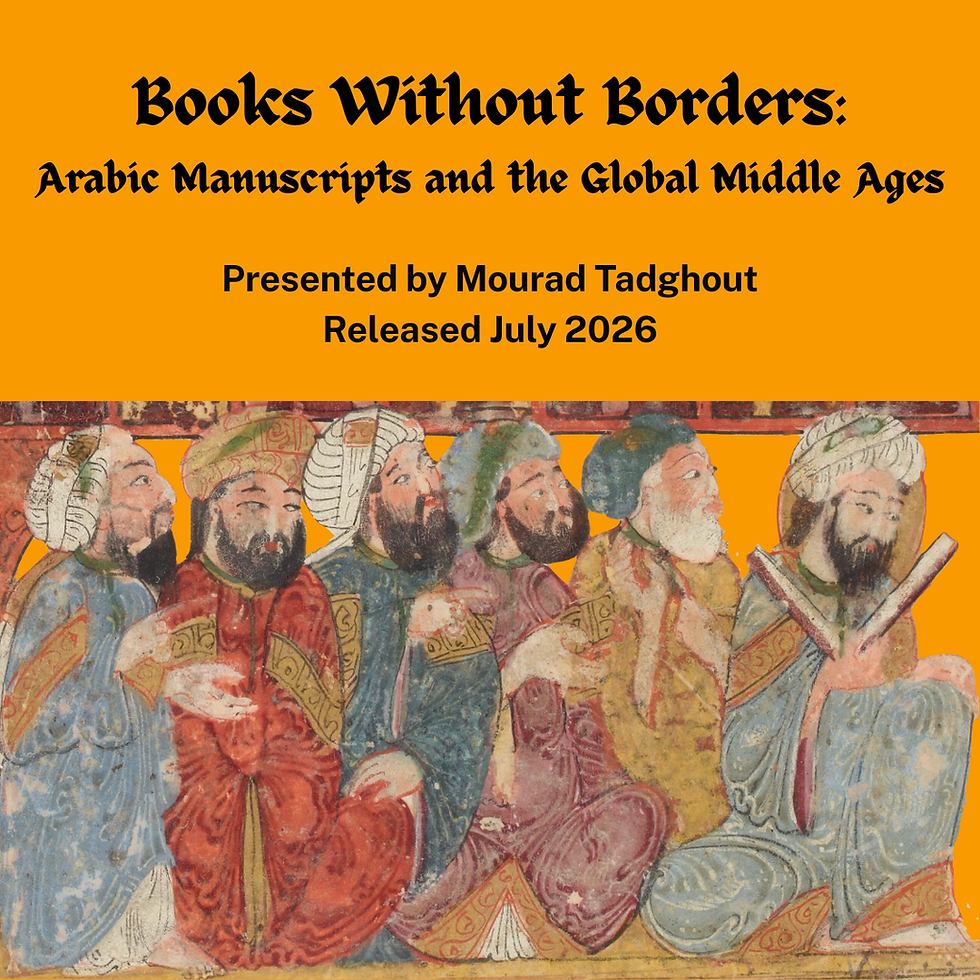

In this episode of The Multicultural Middle Ages Podcast, scholar Mourad Tadghout examines the central role of Arabic manuscript culture in shaping the intellectual history of the medieval world. The episode follows the production, circulation, and transformation of manuscripts from major centers such as Baghdad, Cairo, Córdoba, Fes, and beyond, tracing how texts moved across linguistic, religious, and geographic boundaries.
Using Ibn Sina’s Canon of Medicine as a guiding case study, Tadghout explores how knowledge was not only preserved but actively reworked through processes of copying, annotation, and translation. Particular attention is given to the twelfth- and thirteenth-century translation movements in Toledo and southern Italy, where Arabic scientific and philosophical works were rendered into Latin and integrated into European university curricula.
The episode further considers manuscripts as material objects, embedded in networks of scribes, scholars, and institutions. Through codicological perspectives and recent digital humanities approaches, it reveals how marginalia, ownership notes, and manuscript circulation patterns illuminate a deeply interconnected intellectual world.
Ultimately, Tadghout challenges narratives of a “Dark Age” by demonstrating that medieval knowledge was shaped through sustained cross-cultural collaboration. The episode invites listeners to rethink the Middle Ages as a dynamic and interconnected space of intellectual exchange—sustained by books without borders.
Mourad Tadghout is an independent scholar in medieval intellectual history, specializing in Arabic manuscript culture and the transmission of knowledge across the medieval Mediterranean and Eurasian worlds. His research focuses on the movement of texts, translation practices, and the role of manuscript traditions in shaping cross-cultural intellectual exchange between the Islamic world, Latin Europe, and adjacent scholarly traditions.
Further reading:
Bloom, Jonathan M. (2001). Paper Before Print: The History and Impact of Paper in the Islamic World. Yale University Press.
Burnett, Charles (2009). Arabic into Latin in the Middle Ages: The Translators and Their Intellectual and Social Context. Ashgate.
Endress, Gerhard (2006). “The Circle of Knowledge: Encyclopaedias and Universal Science in Islamic Intellectual History.” In The Encyclopaedia of Islam (2nd ed.). Brill.
Gutas, Dimitri (1998). Greek Thought, Arabic Culture: The Graeco-Arabic Translation Movement in Baghdad and Early ʿAbbāsid Society. Routledge.
Menocal, María Rosa (2002). The Ornament of the World: How Muslims, Jews, and Christians Created a Culture of Tolerance in Medieval Spain. Back Bay Books.
Mommsen, Theodore (1942). “Petrarch’s Conception of the ‘Dark Ages’.” Speculum, 17(2), 226–242.
Pormann, Peter E. & Savage-Smith, Emilie (2007). Medieval Islamic Medicine. Edinburgh University Press.
Siraisi, Nancy G. (1987). Avicenna in Renaissance Italy: The Canon and Medical Teaching in Italian Universities after 1500. Princeton University Press.
Digital Manuscript Collections (optional addition for the podcast platform):
The Wellcome Collection (Medical Manuscripts) – https://wellcomecollection.org
Bibliothèque nationale de France (Gallica Digital Library) – https://gallica.bnf.fr
Qatar Digital Library (Arabic & Islamic Manuscripts) – https://www.qdl.qa
British Library Digitised Manuscripts – https://www.bl.uk/manuscripts
Episode transcript (Note that a time-dynamic transcript is available if you access the episode through a free podcasting platform such as Apple Podcasts or Spotify):
Mourad Tadghout: Imagine a manuscript copied in tenth century Baghdad. A scribe bends carefully over polished paper, guiding a reed pen across the page. The text is a medical treatise, knowledge derived from Greek authorities, translated into Arabic, critically examined by Muslim scholars, refined through observation, and within a new intellectual framework.
Now imagine that text copied and recopied, traveling eastwards. By the twelfth century in Toledo, a multi-language scholarly milieu renders it into Latin. From there, it enters the libraries of Paris, Bologna, and Oxford, where it shapes the education of physicians for centuries. This trajectory is not exceptional. It is emblematic.
much of modern historiography, the Middle Ages has been framed as a predominantly European epoch. Yet manuscript evidence reveals a more complex and interconnected reality.
Rather Than discrete civilizations developing in isolation, Islamic, Latin, Christian, Byzantine... we encounter a web of intellectual exchange sustained by the movement of texts, scholars, and languages.
Arabic manuscripts were not peripheral to medieval intellectual history. They were cons-constitutive of it. By tracing their productions, Circulation and translation, we uncover a global Middle Age structured by transmission rather than isolation.
In the medieval Islamic world, manuscript production was central to scholarly culture from the eighth century onward, particularly under the Abbasid Caliphate. Cities such as Baghdad, Cairo, Damascus, Fez, and Cordoba became major centers of book production and learning.
Arabic functions as a trans-regional scholarly language used not only by Muslim scholars, but also by Christians and Jewish across vast territories. Persian intellectuals composed scientific works in Arabic. Jewish philosophers wrote in Arabic using Hebrew script, so-called Judaeo-Arabic. Christian scholars participated in translation and commentary traditions. Knowledge circulated across confessional and linguistic boundaries.
Manuscripts production was collaborative, and scribes prepared paper, ruled lines, and copied the texts. Patrons commissioned works. Scholars revised drafts. Readers added glosses, marginal annotation that recorded commentary, correction, or debate. Glosses provide invaluable insights into intellectual networks, often preserving layers of intergenerational dialogue.
Arabic manuscripts encompassed medicine, astronomy, mathematics, philosophy, law, theology, poetry, and geography, et cetera. Many preserved Greek works, Aristotle, Galen, Ptolemy, translated into Arabic, often via Syriac intermediaries. Others offered regional contribution that would later influence Latin scholasticism.
Crucially, these manuscripts were mobile. They traveled along trade routes, diplomatic channels, pilgrimage paths, and scholarly networks. Books were bought, sold, gifted, copied, and recopied. A single text might survive in dozens of manuscripts witnesses dispersed across regions. Thus, manuscripts were dynamic nodes within intellectual exchange systems.
To understand how Arabic manuscripts structured medieval connectivity, we may follow one of the most influential works in medical history, The Canon of Medicine, composed in the early 11th century by Ibn Sina-- known in Latin as Avicenna.
The Canon synthesized Greek medical authorities, particularly Galen and Hippocrates, with earlier Islamic scholarship and Ibn Sina' own clinical observation.
It was not merely compilatory. It's organized medical knowledge into a systematic and pedagogically coherent framework. Manuscripts, copies of the Canon circulated widely throughout the Islamic world. Surviving codex reveal ownership statement, marginal annotations, and lecture notes. Students recorded clarification in the margins.
Later physicians inserted corrections. Owners documented dates and places of acquisition. Each manuscripts became a record of live intellectual engagement. In the twelfth century, within the translation milieu of Toledo, The Canon was rendered into Latin, notably by Gerard of Cremona. This translation formed part of a broader movement that transferred Arabic scientific and philosophical works into Latin Europe.
Once translated, The Canon became foundational in European universities. It served as stron-standard medical authority in Bologna, Montpellier, and Paris well into the early modern period. Its authority endured for centuries, shaping medical curricula and scholastic debates. This transmission was not passive reception.
Latin scholars wrote commentaries, raised objections, and integrated Avicennian theory into , Christian intellectual frameworks. The text evolved within its new context. What began as synthesis in Central Asia became a pillar of European medical education. This case illustrates a layered model of transmission: Greek into Arabic, Arabic into Latin, commentary upon commentary.
Rather than a unidirectional flow from East to West, we observe recursive circulation across languages and regions.
The translation of the Canon formed part of broader 12th and 13th century translation movement. Centers s- such as Toledo and Southern Italy facilitated systematic translation projects in medicine, astronomy, mathematics, and philosophy.
At a time when much of Aristotle's corpus was unavailable in Latin, Arabic translation, often accompanied by extensive commentaries, served as The intellectual heritage of late antiquity had been preserved, debated, and expanded in Arabic. Through translation, this scholarship entered the institutional frameworks of European universities.
By the 13th century, universities in Bologna, Paris, and Montpellier formalized circular, dependent, open translated texts. Manuscripts availability determined pedagogy. Every lecture required a copy. Every commentary required a manuscript to annotate. The infrastructure of medieval education was materially dependent on manuscript networks.
Surviving codex in Istanbul, Cairo, Fez, Madrid, Paris, and Oxford, for example, preserve evidence of this interconnected world.
Colophons record dates and scribes, ownership . Glosses reveal intellectual debate. These material traces corroborate the broader historical picture of structured cross-cultural collaboration.
The notion of European Dark Age emerged largely from Renaissance and Enlightenment historiography seeking to distinguish modernity from a perceived medieval decline. Contemporary scholarship has substantially revised this narrative.
Manuscripts evidence reveals continuity rather than rupture. Preservation, adaptation, translation and innovation characterized the medieval centuries. Arabic scholarship played a central role in this continuity, mediating ancient knowledge and contributing original thought. A multicultural perspective does not invert older Eurocentric hierarchy enabling comparative manuscript study across dispersed collections.
Digital scholarship reveals textual families and transmission patterns with increasing precision. The material record confirms what intellectual history suggests. The medieval world was interconnected on a trans-regional scale.
When we speak of Arabic manuscripts, we are referring to a tradition that stretches back more than 13 centuries. Some of the earliest surviving Arabic manuscripts date to the late 7th and early 8th centuries. Among them are early Quranic codex writing in angular script, often referred to as Kufi.
These manuscripts are striking not only for their religious importance, but also for what they reveal about the emergence of a writing scholarly culture in Arabic. One of the most famous examples is the manuscripts commonly known as the Birmingham Quran manuscripts, whose parchment has been radiocarbon dated to the seventh century.
While the dating of ink and writing remains debates, such manuscripts remind us that Arabic literacy and textual preservation developed rapidly within a generation of Islam's emergence.
Papyri from Egypt, and scientific fragments show that Arabic became, within a - remarkably short time, a language of governance, scholarship, and intellectual exchange.
The survival of these early manuscripts is fragmentary. Yet even in fragments, they testify to the formation of textual civilization, one in which writing, copying, and preservation became central to social and intellectual life.
The manuscripts tradition did not suddenly appear in its mature form. scripts changed. Page layouts developed. The exerkel marks were standardized. What we see in these early witnesses is the beginning of long process of refinement that would culminate in the sophisticated book cultures of later centuries.
as Arabic manuscripts culture matured Certain cities became major centers of production and circulation. In the Abbasid period, Baghdad emerged as a leading intellectual hub. The translation movement of the ninth and tenth century fostered a demand for books in philosophy, medicine, astronomy and mathematics.
Scholars, patrons, scribes, and booksellers formed a dynamic ecosystem of knowledge production. Cairo, especially under the Fatimid and later on the Mamluks, developed vast libraries and vibrant books, markets. Damascus and Aleppo played crucial roles in scholarly transmission across the Eastern Mediterranean.
Al Andalus, Cordoba became renowned for its libraries and scholarly patronage. By the tenth century, it was described by contemporaries as one of the great intellectual capitals of Europe. Manuscripts produced there circulated across North Africa and into Latin Christian treasuries.
Further east, cities such as Nisapur, Bukhara, and later Tabriz and Herat cultivated refined manuscript arts, particularly in the Persianate world. These centers were not isolated. They were connected through trade routes, pilgrimage networks, diplomatic missions, and scholarly travel.
Book production was supported by professional scribes, paper makers, illum illuminators, and binders. Market for books flourished. Manuscripts were commissioned by rulers, endowed to madrasa, donated to mosques, and exchanged amongst scholars. These urban centers formed a trans-regional network of intellectual production.
Knowledge did not radiate from a single capital. It circulated through multiple interconnected hubs across Africa, the Middle East, Central Asia, and Iberia.
To understand manuscripts fully, historians today rely not only on textual analysis , but also on codicology: the study of manuscripts as physical objects. Codi-co-codicology examines parchment or paper in composition, binding structures, choir formation, rolling patterns, and marginal annotations.
This material features help scholars reconstruct when and where a manuscript was produced, how it was used, and how it traveled. A manuscript is not merely a container of text. It is an artific-artifact shaped by economic conditions, technological choices, and social practices. The quality of paper may indicate trade networks. The style of script may suggest regional training. Ownership notes may reveal patterns of scholarly mobility.
In recent decades, digitization projects have transformed manuscript studies. Libraries in Istanbul, Cairo, Fez, Paris, London, and Doha, for example, have made thousands of Arabic manuscripts available online. High resolution images allow scholars to compare copies across continents without physical travel. Digital tools now enable researchers to trace textual variants, reconstruct transmission histories, and identify previously unknown relationship between manuscripts.
The digital turn does not replace the physical manuscripts, but it expands access and collaboration. In this sense, the study of Arabic manuscripts embodies a continuity between past and present.
Medieval scholars built networks of knowledge through copying and translation. Today, digital platform create new networks of scholarly exchange across borders.
Arabic manuscripts were not margins to medieval intellectual history. They were foundational from the earliest codex to the great scholarly compendia of later centuries. They transmitted knowledge across continents.
They connected Baghdad to Toledo, Central Asia to Paris, Muslim scholars to Christian and Jewish intellectual. They emerged from vibrant centers of production, cities where paper, ink, and disciplined hands turned thought into durable form. To follow the journey of manuscript is to witness the architecture of medieval connectivity, constructed not political unity, but through patient acts of copying, translation, annotating, and teaching.
Today, through codico-codicology and digitization We continue that journey. We read not only the words, but the material traces of movement, exchange, and collaboration.
The Middle Ages were not defined by darkness, but by circulation.
In recognizing this interconnected manuscripts world, we are invited to reconsider how we narrate the past. The history of the Middle Ages is not a sequence of isolated civilizations, but a shared intellectual landscape shaped by translation, adaptation, and dialogue. To study these manuscripts is therefore not only to recover texts, but to recover relationships.
Relationships that remind us that knowledge has always crossed borders more easily than we imagine. Finally, I would like to express my sincere thanks to the team behind the Multicultural Middle Ages podcast whose guidance, support, and dedication have made it possible to share this research with a wider audience.
Listen here or on any podcasting platform.


Comments